Jensen Huang says Nvidia is pulling back from OpenAI and Anthropic
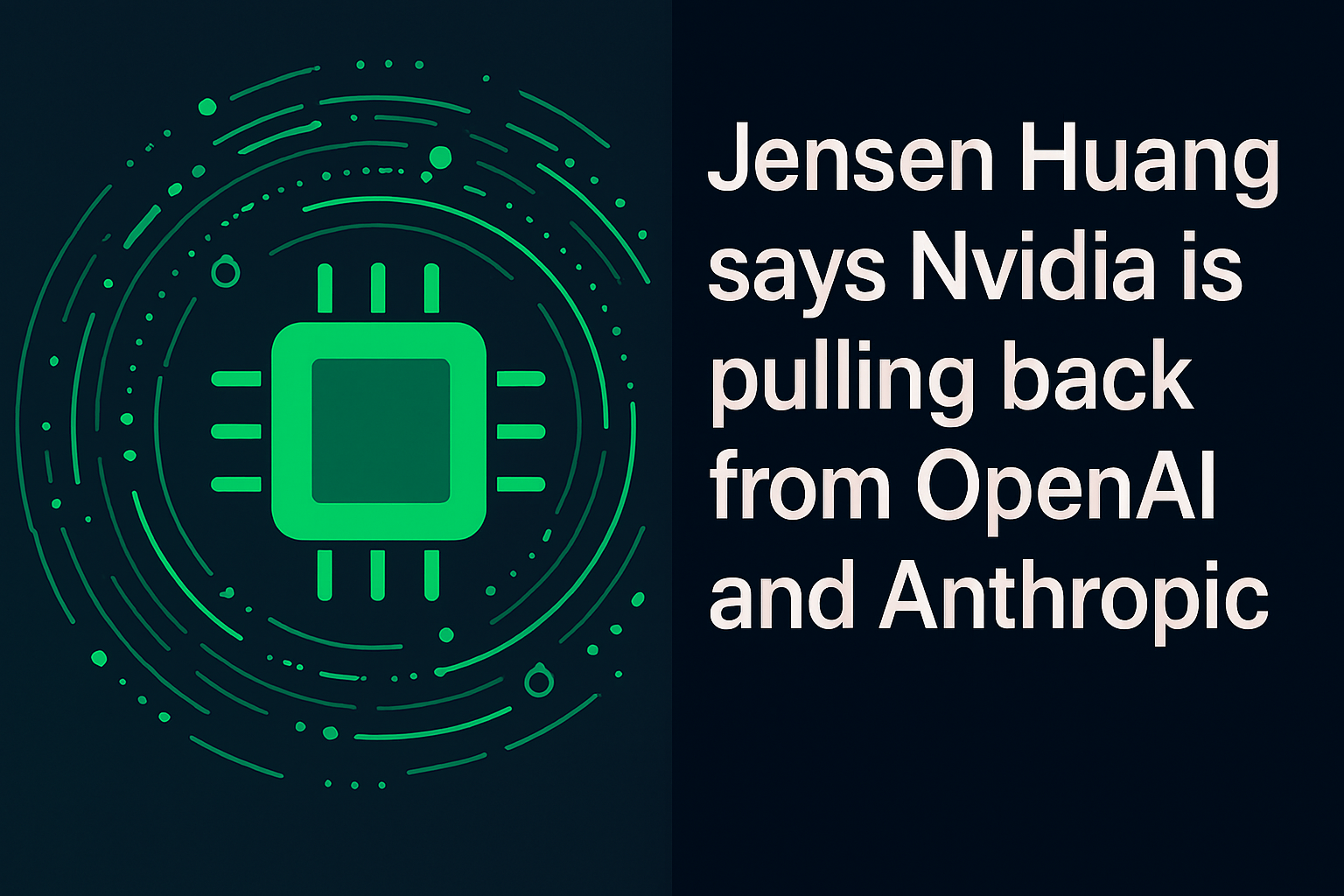
In the rapidly evolving world of artificial intelligence, every statement from a titan like Nvidia’s CEO, Jensen Huang, sends ripples across the industry. Recently, Huang made a pronouncement that has left many scratching their heads: Jensen Huang says Nvidia is pulling back from OpenAI and Anthropic, but his explanation raises more questions than it answers. This declaration, coming from the leader of the company powering much of the AI revolution, suggests a significant shift in strategy, yet its precise meaning remains shrouded in ambiguity. What does this “pullback” truly entail for Nvidia, its erstwhile partners, and the broader AI ecosystem? The implications are vast, touching upon competition, technological independence, and the future trajectory of AI development, making this a pivotal moment for understanding the evolving dynamics of AI infrastructure.
Nvidia has been the undisputed king of AI infrastructure, with its GPUs forming the backbone of virtually every major AI model’s training and deployment. Companies like OpenAI and Anthropic, at the forefront of large language model (LLM) innovation, have historically relied heavily on Nvidia’s powerful hardware to develop and scale their groundbreaking technologies. Therefore, any declared reduction in engagement between these critical players warrants close examination. Is it a strategic divestment, a pivot towards different partners, or something more nuanced that reshapes the competitive landscape?
Decoding Jensen Huang’s Ambiguous Statements on AI Partnerships
When a leader of Huang’s stature speaks, his words are usually carefully chosen and strategically placed. However, his comments regarding OpenAI and Anthropic have defied straightforward interpretation, sparking a flurry of analysis and speculation across the tech world. Initial reports suggested a distancing, a strategic re-evaluation of Nvidia’s direct support or investment in these specific companies. This immediately ignited a debate:
- Is Nvidia quietly creating its own competing AI models, moving from enabler to direct competitor?
- Are OpenAI and Anthropic seeking alternative hardware suppliers, perhaps even exploring the development of their own custom AI chips to reduce dependency?
- Does this signify a natural progression where Nvidia, as a mature infrastructure provider, focuses more broadly on empowering thousands of AI innovators rather than deeply integrating with just a few application partners?
The ambiguity surrounding Huang’s explanation is particularly striking. He didn’t explicitly detail the nature of the “pullback”—whether it involved reduced hardware sales, a cessation of collaborative research projects, or a shift in investment priorities. This lack of clarity is precisely why Jensen Huang says Nvidia is pulling back from OpenAI and Anthropic, but his explanation raises more questions than it answers, leaving analysts and industry watchers to meticulously piece together the potential motives and long-term consequences.
For a deeper dive into Nvidia’s foundational role in AI prior to these recent shifts, explore our article on Nvidia’s Dominance in AI Chips, which highlights their strategic importance and technological leadership in the sector.

The Potential Motivations Behind Nvidia’s Strategic Shift
Several underlying factors could be driving Nvidia’s decision, or at least shaping Huang’s public presentation of it. One prominent theory suggests that as OpenAI and Anthropic mature and expand their offerings, they may increasingly be seen as direct competitors in certain AI service verticals, rather than purely as hardware clients. Nvidia, with its vast resources, expanding software ecosystem, and undeniable ambition, might be looking to play a more central role in the entire AI stack, from foundational chips to sophisticated platforms and perhaps even proprietary AI models.
Another compelling angle is diversification and risk management. Nvidia’s unparalleled success is heavily tied to its GPU technology. However, the AI landscape is dynamic and rapidly evolving. Other major companies are investing heavily in custom AI chips (ASICs), like Google’s TPUs or Amazon’s Trainium and Inferentia. Perhaps Nvidia is subtly encouraging its customers to diversify their hardware strategies, reducing their reliance on any single vendor, even itself. This might seem counterintuitive in the short term, but it could be a savvy long-term play to foster a healthier, more diverse market where Nvidia remains a crucial, but not the sole, indispensable player.
Furthermore, Nvidia has been diligently building out its own comprehensive AI ecosystem, including its widely adopted CUDA platform, the Nvidia AI Enterprise software suite, and cloud services like Nvidia DGX Cloud. This growing internal capability and desire to own more of the AI value chain might naturally lead to a re-evaluation of partnerships. Nvidia might prefer to work with a broader array of clients using its standardized platform, rather than focusing too intensely on just a few behemoths. The core message that Jensen Huang says Nvidia is pulling back from OpenAI and Anthropic, but his explanation raises more questions than it answers could be a deliberate strategy to signal a more independent and diversified path for Nvidia itself, moving towards a platform-centric model.
Implications for OpenAI and Anthropic in a Changing Landscape
For OpenAI and Anthropic, Huang’s comments carry significant weight and demand a strategic response. These companies have become synonymous with cutting-edge LLMs, requiring immense and continuous computational power for both training and inference. While they likely have robust contracts and existing relationships that extend beyond simple public declarations, a public “pullback” from their primary hardware provider could prompt them to:
- Accelerate and intensify their own custom chip development efforts, aiming for greater hardware autonomy.
- Proactively diversify their hardware suppliers, perhaps turning to competitors like AMD and Intel, or leveraging cloud providers’ proprietary silicon more aggressively.
- Reassess their long-term strategic alignment with core infrastructure providers, seeking partners that offer deeper, more stable commitments.
The competitive landscape in AI is heating up, with tech giants like Microsoft, Google, and Amazon making aggressive moves to capture market share. A perceived weakening of the Nvidia-OpenAI/Anthropic bond could open doors for other players to strengthen their own positions by offering alternative compute solutions or more attractive partnership terms. It’s a critical moment for these leading AI labs to demonstrate their resilience and adaptability, especially since Jensen Huang says Nvidia is pulling back from OpenAI and Anthropic, but his explanation raises more questions than it answers about their future reliance on Nvidia’s offerings and the stability of their hardware supply chain.
Nvidia’s Broader AI Ecosystem Strategy: Beyond Just Chips
Nvidia is not merely a chip manufacturer; it has meticulously transformed itself into a comprehensive AI platform company. Its strategy extends far beyond selling GPUs to building an expansive ecosystem of software, developer tools, and cloud services. This includes:
- CUDA: The ubiquitous parallel computing platform that effectively locks developers into Nvidia’s architecture, creating a powerful moat.
- Nvidia AI Enterprise: A robust software suite designed for enterprise-grade AI development and deployment, offering stability and support.
- Nvidia Omniverse: A platform for virtual collaboration, industrial simulation, and digital twins, which is becoming increasingly relevant for large-scale industrial AI applications.
- Strategic Investments: Nvidia actively invests in numerous AI startups globally, some of whom might eventually compete with OpenAI or Anthropic in specific niches, signaling a broader portfolio approach.
Given this expansive vision, it’s plausible that the “pullback” is less about severing ties and more about rebalancing relationships within Nvidia’s larger strategic framework. They might be shifting from a highly tailored, intimate partnership model with a few key players to a more standardized, platform-centric approach available to a wider array of customers. This aligns with a business model that seeks to enable thousands of AI companies, not just a select few, thereby diversifying revenue streams and reducing dependency on any single client. This expansive vision suggests a deeper strategic pivot, especially as Jensen Huang says Nvidia is pulling back from OpenAI and Anthropic, but his explanation raises more questions than it answers about specific collaborative efforts and Nvidia’s long-term commitments to individual AI innovators.
What Does “Pulling Back” Actually Mean in Practice?
Without specific details from Nvidia, the term “pulling back” can be interpreted in several nuanced ways, each with distinct implications:
- Reduced Direct Investment: Nvidia might be scaling back financial investments or joint venture participation in OpenAI and Anthropic, choosing instead to deploy capital elsewhere or directly into its own proprietary AI initiatives.
- Shift in Resource Allocation: It could mean less dedicated engineering support, diminished priority access to bleeding-edge hardware, or fewer bespoke solutions for these specific companies, with resources reallocated to other customers or internal projects.
- Market Signal: It could be a deliberate strategic declaration to the broader market that Nvidia is not beholden to any single AI lab and is open for business with all players, including those who might eventually compete with OpenAI or Anthropic. This serves as a powerful message of neutrality and broad enablement, positioning Nvidia as the essential infrastructure layer for the entire AI industry.
- Natural Evolution: As pioneering AI labs, OpenAI and Anthropic might be graduating from needing bespoke Nvidia partnerships, now operating as large, independent entities that simply purchase hardware like any other major client, reducing the need for unique strategic alliances.
The most intriguing aspect is that Jensen Huang says Nvidia is pulling back from OpenAI and Anthropic, but his explanation raises more questions than it answers because it creates a vacuum of information. This vacuum forces the industry to speculate, potentially serving Nvidia’s strategic interests by keeping competitors and partners guessing, while subtly redefining its role in the AI supply chain. This move could empower Nvidia to be perceived as a neutral, foundational layer for the entire AI industry, rather than deeply entwined with specific end-product innovators.
Consider the broader implications for the entire AI supply chain. Nvidia’s hardware is undeniably foundational, but as AI models become more efficient, specialized, and as bespoke hardware solutions emerge from various players, the dynamics inevitably shift. This “pullback” might signal Nvidia’s acknowledgment of this evolving market and its proactive adjustment to maintain dominance by diversifying its risk and its customer base. It’s a move that underscores the strategic importance of hardware in an increasingly software-defined world, where flexibility and broad reach are paramount.

The Future of AI Partnerships and Competition
Huang’s statements underscore a critical juncture in the AI industry. The early days of close, almost symbiotic relationships between foundational hardware providers and leading AI labs might be evolving into a more complex, multi-faceted, and often competitive landscape. As AI technology becomes more commoditized and specialized, companies will naturally seek to optimize their dependencies, diversify their supply chains, and strategically protect their intellectual property and market position.
This situation highlights the ongoing tension between collaboration and competition. While Nvidia provides the essential tools for AI development, the sophisticated models developed by OpenAI and Anthropic are powerful entities that could eventually influence hardware requirements, or even pose a direct competitive threat in certain AI applications or services. It’s a delicate balance, and the ambiguity persists because Jensen Huang says Nvidia is pulling back from OpenAI and Anthropic, but his explanation raises more questions than it answers regarding the specific nature and intent of the reduction in engagement, forcing the industry to adapt to an opaque strategic shift.
Indeed, one could argue that a more arms-length relationship benefits all parties in the long run, fostering a competitive yet healthy ecosystem. Nvidia remains the crucial supplier, but by not being overly tied to specific model developers, it can cater to a wider market without perceived conflicts of interest. Conversely, OpenAI and Anthropic gain more autonomy to explore various hardware options and strategic alliances without being constrained by an over-reliance on a single vendor. This strategic independence is vital as the AI sector matures and its applications become ubiquitous.
Industry experts at publications like The Verge and TechCrunch have also been closely following these developments, offering diverse perspectives on what this shift could mean for the broader tech landscape. Their analyses often touch upon the intricacies of strategic partnerships, the dynamics of competition, and the challenges of maintaining market leadership within the highly concentrated AI chip market.
Conclusion: An Unfolding Narrative of Strategic Recalibration
The pronouncement that Jensen Huang says Nvidia is pulling back from OpenAI and Anthropic, but his explanation raises more questions than it answers marks a significant moment in the AI industry. It signals a potential, yet profoundly ambiguous, recalibration of relationships between the foundational hardware provider and two of the most influential AI model developers. Whether this “pullback” is a subtle shift in focus, a strategic maneuver to broaden Nvidia’s market reach, or a precursor to more direct competition across the AI stack, remains largely speculative.
What is clear is that Nvidia, under Jensen Huang’s visionary leadership, is not content to simply be a supplier of chips. It aims to be a foundational force, influencing and enabling every layer of the AI stack, from core silicon to cloud services and sophisticated software platforms. This strategic move, however ambiguous its articulation, forces a crucial re-evaluation of dependencies across the entire AI industry and underscores the ever-present tension between collaboration and competition in the relentless race for AI supremacy. The coming months and years will undoubtedly shed more light on the true nature of this strategic shift and its long-term implications for the future of artificial intelligence.
Ultimately, the move emphasizes the sheer dynamism and rapid evolution of the AI industry. No partnership is truly permanent in a sector driven by innovation and disruption, and every player, from chip manufacturers to model developers, is constantly seeking to optimize its position for long-term growth and influence. Jensen Huang’s statement is not merely a withdrawal; it’s a powerful signal of an evolving landscape where strategic independence and diversified alliances will define the next phase of AI innovation, especially given that Jensen Huang says Nvidia is pulling back from OpenAI and Anthropic, but his explanation raises more questions than it answers about precise implications and future collaboration models.
#AIBusinessStrategy #NvidiaAI #OpenAIChat #AnthropicAI #TechPartnerships #AIHardware #JensenHuang #AIShift #TechIndustry #ArtificialIntelligence #AIChips #StrategicMoves #FutureOfAI #NvidiaStrategy #CloudAI