Why OpenAI Really Shut Down Sora
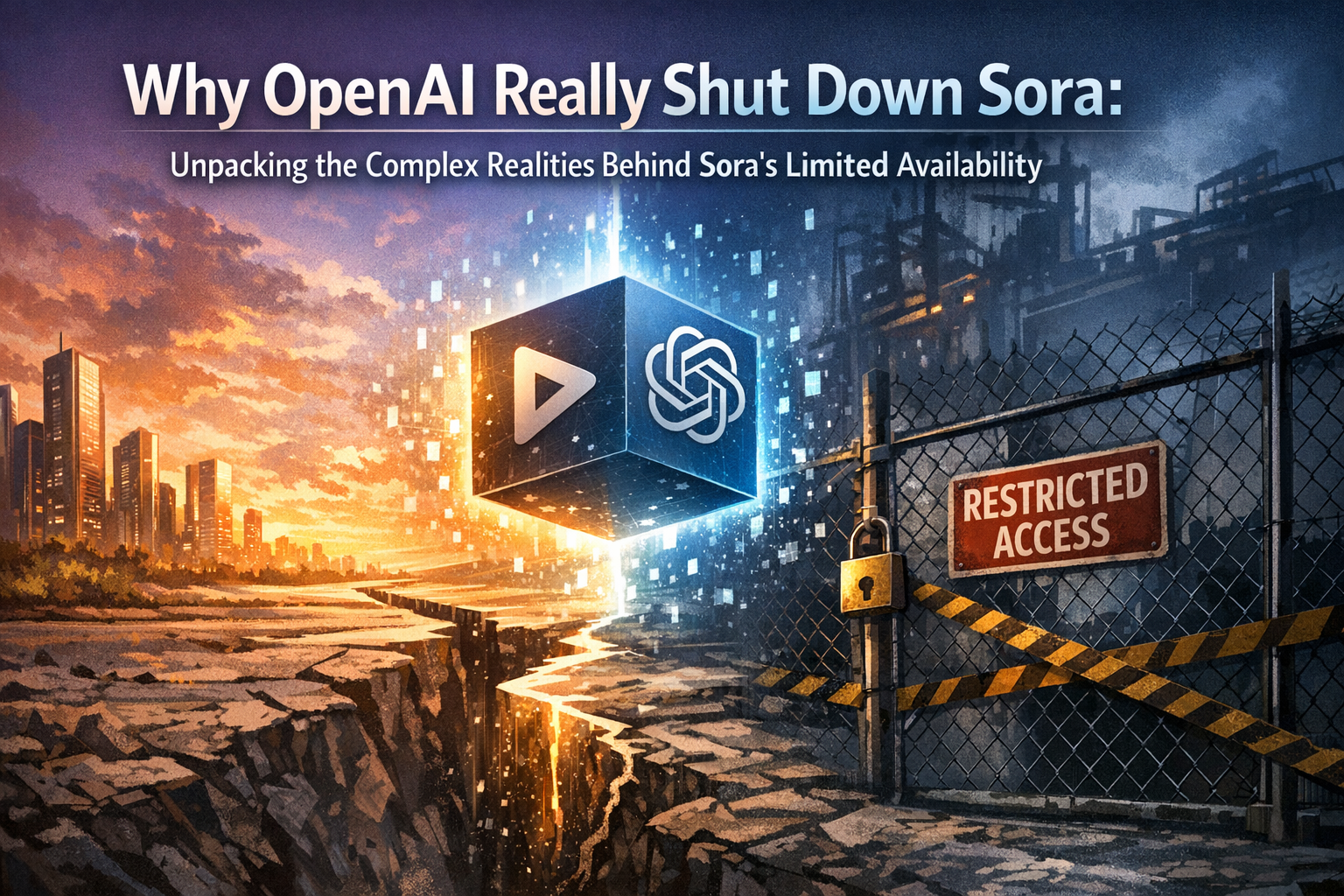
The buzz around OpenAI’s text-to-video model, Sora, was undeniable. Its ability to generate stunningly realistic and imaginative video sequences from simple text prompts sent shockwaves through the creative and technological worlds. Yet, for many, the initial excitement quickly morphed into confusion and speculation. A common question echoing through forums and news feeds is: Why OpenAI really shut down Sora? It’s a perception that arises from Sora’s highly restricted access, leading many to believe the groundbreaking AI tool has been pulled from development or shelved indefinitely. The reality, however, is far more nuanced than a simple “shutdown.” While Sora hasn’t been technically ‘shut down,’ its current status of limited availability is deliberate and rooted in a complex interplay of ethical considerations, safety protocols, computational demands, and strategic planning. This deep dive aims to unravel the genuine factors preventing Sora from becoming a widely accessible public tool, shedding light on why its creators are exercising such profound caution.
The Illusion of a Shutdown: Understanding Sora’s Controlled Rollout
To understand why many believe Sora has been ‘shut down,’ it’s crucial to first clarify its actual status. Sora is not defunct; it’s very much alive and in active development. OpenAI has granted access to a select group of visual artists, designers, and filmmakers for testing and feedback. This controlled rollout is a standard practice for groundbreaking technologies, especially those with significant potential impact. The perception of a shutdown stems from the general public’s inability to access it, contrasting sharply with the initial hype that suggested a rapid democratization of video creation. OpenAI’s cautious approach is a direct response to the immense power and potential risks associated with generative AI of this magnitude. They are navigating uncharted waters, where the implications of releasing such a tool without stringent safeguards could have far-reaching societal consequences. The slow, deliberate pace is not a sign of failure or abandonment, but rather a testament to the gravity with which OpenAI views its responsibilities in deploying powerful AI models.
Think of it like the early days of autonomous vehicles. While the technology existed, public access was severely limited due to safety concerns and the need for rigorous testing in controlled environments. Similarly, Sora, while awe-inspiring, presents a new frontier in media creation that demands careful consideration before widespread release. The controlled access allows OpenAI to gather crucial data, identify potential biases, refine the model’s capabilities, and most importantly, develop robust safety mechanisms. This phase is critical for ensuring that when Sora eventually does become more widely available, it does so in a way that maximizes benefits while minimizing harm. The “shutdown” narrative, therefore, is a misinterpretation of a highly strategic and responsible deployment process, reflecting the understandable impatience of a public eager to get their hands on revolutionary technology.

Safety First: Navigating the Minefield of Deepfakes and Misinformation
One of the primary reasons why OpenAI really shut down Sora from public access (or severely restricted it) is the profound concern over misuse, particularly in the realm of deepfakes and misinformation. Sora’s capability to generate hyper-realistic video content presents an unprecedented challenge to the integrity of visual information. Imagine the ease with which convincing, yet entirely fabricated, videos could be created to spread propaganda, manipulate public opinion, or impersonate individuals with malicious intent. This isn’t a hypothetical threat; the potential for such abuse is very real and has already been observed with less sophisticated generative AI tools.
OpenAI is acutely aware of the ethical tightrope they walk. Releasing Sora prematurely, without robust safeguards, could unleash a torrent of synthetic media that would make discerning truth from fiction incredibly difficult. This concern is amplified in an era already grappling with widespread disinformation campaigns. Therefore, a significant portion of Sora’s development time is dedicated to building and refining safety mechanisms. This includes implementing watermarks, developing detection tools for AI-generated content, and establishing strict usage policies. They are engaging with experts in fields ranging from ethics to cybersecurity to anticipate potential harms and develop strategies to mitigate them. The goal isn’t just to make Sora powerful, but to make it responsible. This proactive stance on safety is a monumental undertaking, requiring extensive research and development to ensure the model cannot be easily exploited for harmful purposes.
- Preventing Malicious Content: Sora could be used to create highly convincing fake news, propaganda, or even non-consensual explicit deepfakes.
- Maintaining Trust: The widespread availability of undetectable AI-generated video could erode public trust in all visual media.
- Ethical Deployment: OpenAI is committed to responsible AI development, meaning societal impact must be prioritized over rapid deployment.
The Enormous Computational Cost: A Barrier to Public Access
Beyond safety and ethics, a very practical and significant barrier influencing why OpenAI really shut down Sora from public view is the immense computational cost associated with running such a sophisticated model. Generating even a short video clip with Sora requires an extraordinary amount of processing power, far surpassing that needed for generating text or images.
Consider the complexity: Sora needs to understand natural language prompts, translate them into a coherent narrative, animate countless pixels across frames, ensure temporal consistency (objects moving realistically, maintaining their appearance), and render high-resolution output – all in a fraction of a second. This process consumes vast quantities of electricity and demands access to specialized, high-performance computing infrastructure, specifically powerful GPUs. Providing this capability to millions of users simultaneously would be astronomically expensive, requiring an infrastructure investment that might not yet be commercially viable or scalable for widespread public consumption.
Even for a well-resourced organization like OpenAI, scaling Sora to a public-facing service presents a formidable challenge. The costs involved in maintaining the necessary server farms, cooling systems, and energy consumption could quickly become prohibitive. This economic reality plays a crucial role in the strategic decision to keep Sora in a limited testing phase. It allows OpenAI to optimize the model for efficiency, explore more cost-effective inference methods, and potentially develop tiered access models before facing the full financial implications of a global rollout. The high barrier to entry, in terms of computing resources, ensures that Sora’s journey from development to widespread utility will be gradual and carefully managed.
Addressing Bias and Ensuring Fairness in Generative AI
Another critical aspect that contributes to Sora’s restricted status is the ongoing effort to identify and mitigate biases within the model. Like all AI trained on vast datasets of existing information, Sora can inadvertently inherit and amplify societal biases present in that data. If the training data disproportionately features certain demographics, stereotypes, or cultural representations, Sora’s outputs will reflect those biases, potentially perpetuating harmful stereotypes in its generated videos.
For instance, if the training data is skewed towards specific gender roles, racial representations, or even aesthetic preferences, Sora might consistently generate videos that reinforce these limited perspectives. OpenAI is dedicated to building AI that is fair and equitable, and addressing these inherent biases is a continuous and complex process. It involves meticulous data curation, advanced algorithmic techniques for bias detection, and iterative testing with a diverse group of users. This meticulous process cannot be rushed, as the long-term societal impact of biased AI tools could be significant. Ensuring fairness means taking the time to understand how Sora interprets and responds to prompts across different cultures, demographics, and contexts, a task that is best performed in a controlled environment before a wider release.

Strategic Deployment and Future Vision
Finally, the restricted access to Sora is also a component of OpenAI’s broader strategic vision for AI deployment. They are not merely building tools; they are shaping the future of human-AI interaction. This requires a carefully orchestrated rollout that considers not only the technical capabilities but also the societal integration and economic implications of such powerful technology. By keeping Sora in a limited beta, OpenAI gains several strategic advantages:
- Feedback Loop: Gathering in-depth feedback from a diverse group of professional users allows for targeted improvements and bug fixes that might not be evident in internal testing.
- Market Preparation: The gradual introduction allows industries to prepare for the disruptive potential of text-to-video AI, fostering innovation rather than immediate displacement. Check out insights on AI’s impact on industries on TechPerByte.com.
- Partnerships and Integrations: Limited access facilitates strategic partnerships and integrations with other platforms or creative tools, ensuring a smoother ecosystem transition.
- Regulatory Engagement: It provides time to engage with policymakers and regulators, helping to shape future legislation around generative AI. Learn more about technology trends and regulations at TechPerByte.com.
OpenAI’s history with models like GPT-3 and DALL-E also provides a template. These models initially had limited access before gradually becoming more widely available. This phased approach allows for continuous learning, adaptation, and risk management. The “shutdown” perception, therefore, is a misreading of a deliberate, long-term strategy aimed at responsible and impactful innovation.
Moreover, the continuous advancements in AI mean that Sora itself is likely still evolving rapidly. What we saw in the initial demos was impressive, but OpenAI is undoubtedly working on improving its coherence, fidelity, and control mechanisms. Releasing a product before it meets stringent internal benchmarks, or before the necessary guardrails are robustly in place, would be counterproductive to their mission of safe and beneficial AI. This iterative development process, coupled with the need for careful regulatory and societal integration, is a core reason for the controlled environment Sora currently operates within. It’s about ensuring that when Sora is finally ready for the world, it arrives as a refined, responsible, and truly transformative tool, rather than a rushed product fraught with unforeseen challenges.
The conversation around AI ethics is constantly evolving, with new challenges and considerations emerging regularly. OpenAI, as a leader in the field, understands that they must not only innovate technologically but also lead in establishing ethical frameworks and best practices. This requires extensive collaboration with the broader AI community, ethicists, legal experts, and even the public itself. For example, discussions around digital rights, the provenance of AI-generated content, and the economic impact on creative professionals are ongoing. The slow and measured approach to Sora’s release enables these vital conversations to take place and allows OpenAI to integrate feedback into the model’s development and deployment strategy. This commitment to a holistic approach, encompassing not just the code but its profound societal implications, underlines the true motivations behind Sora’s current, limited status.
The future of AI-generated video is immense, and Sora is at its forefront. The decision to manage its release with such meticulous care reflects not a failure or a retraction, but a deep commitment to ensuring that this powerful technology serves humanity positively. OpenAI is essentially taking a “measure twice, cut once” approach, recognizing the irreversible nature of releasing such a tool without adequate preparation. This patient strategy, while frustrating for those eager to experiment with Sora, is ultimately designed to prevent future regrets and ensure a more stable and beneficial integration of advanced AI into our lives. For more on the future implications of AI, readers can explore resources like MIT Technology Review or OpenAI’s official blog for their latest research and announcements.
Conclusion: Sora’s Path to Public Unveiling
The perception that OpenAI has ‘shut down’ Sora is a natural byproduct of its limited availability and the intense public interest it generated. However, the reality is far from a cessation of development. Instead, the strategic decision to restrict public access to Sora is a multifaceted one, driven by critical considerations such as preventing the spread of misinformation and deepfakes, managing the extraordinary computational costs, mitigating inherent biases, and adhering to a responsible, phased deployment strategy. OpenAI is navigating the complex frontier of advanced generative AI with a profound sense of responsibility. Rather than being shut down, Sora is undergoing a rigorous incubation period, being refined, tested, and fortified with essential safeguards. When it eventually makes its broader public debut, it will be a tool not just of immense creative power, but also one that has been carefully considered for its ethical implications and societal impact, ready to transform the landscape of digital content creation responsibly. The wait, while arduous, is for a future where innovation and responsibility go hand-in-hand.
#AI #GenerativeAI #Sora #OpenAI #VideoGeneration #AIethics #TechnologyNews #FutureofTech