
15% of Americans Would Work for an AI Boss, New Poll Finds
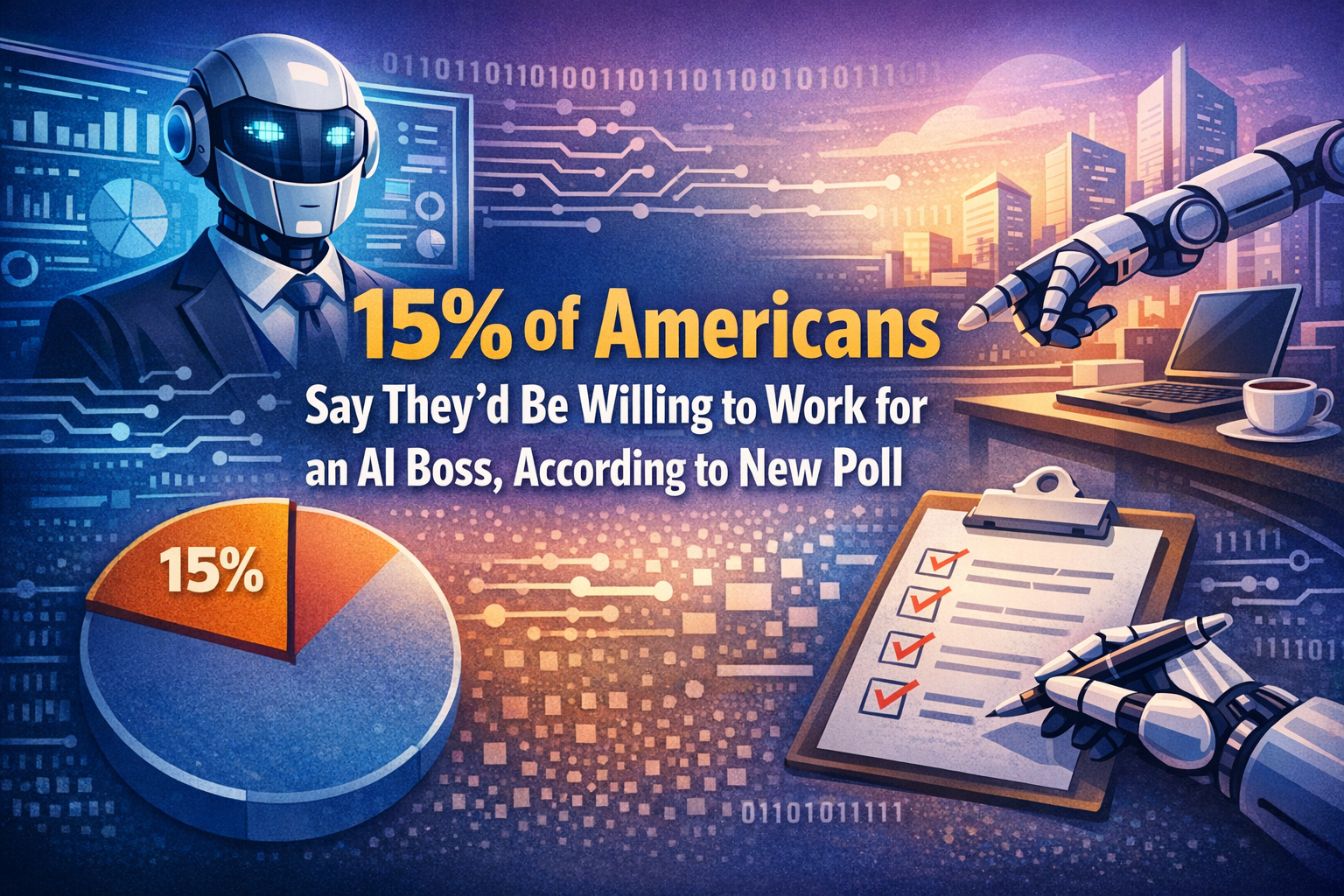
The landscape of the modern workplace is undergoing a profound transformation, driven largely by the relentless march of artificial intelligence. From automating mundane tasks to assisting in complex decision-making, AI’s influence is undeniable. But what happens when AI steps out of the assistant role and into a leadership position? A recent poll has unveiled a fascinating insight: a notable 15% of Americans say they’d be willing to work for an AI boss, according to new poll findings. This statistic, while representing a minority, sparks a crucial conversation about the evolving relationship between humans and technology in our professional lives. It challenges our preconceived notions of management and opens a window into a future where algorithms might dictate our daily tasks, performance reviews, and even career trajectories.
This willingness, though modest, suggests a growing acceptance or perhaps a curiosity about AI’s potential beyond its current applications. For years, the idea of a robot supervisor has been confined to science fiction, conjuring images of dystopian workplaces or hyper-efficient, emotionless overlords. Yet, as AI technologies become more sophisticated, integrating seamlessly into operational workflows, the line between an AI tool and an AI manager begins to blur. Understanding the motivations behind this 15% is key to anticipating future workplace trends and preparing for a potentially unprecedented shift in organizational structures.
The Algorithmic Ascendancy: AI’s Evolving Role in the Workplace
Artificial intelligence has steadily moved from the periphery to the core of business operations. Initially, AI tools were lauded for their ability to handle repetitive, data-intensive tasks, freeing up human workers for more creative or strategic endeavors. We’ve seen AI power customer service chatbots, optimize supply chains, and even personalize learning experiences. Now, its capabilities are extending into areas traditionally reserved for human judgment and interaction. Performance monitoring, resource allocation, scheduling, and even some aspects of feedback are increasingly being influenced or directly managed by AI systems.
This evolution isn’t just about efficiency; it’s about a fundamental redefinition of roles. As AI algorithms become adept at processing vast amounts of data and identifying patterns that human managers might miss, their potential as supervisors becomes increasingly apparent. They can track productivity with granular detail, identify bottlenecks in workflows, and even suggest optimal paths for project completion. This shift towards algorithmic management is already subtly present in many gig economy platforms, where an algorithm often assigns tasks, evaluates performance, and determines compensation, acting as an unseen, digital boss.
The poll’s revelation that 15% of Americans say they’d be willing to work for an AI boss, according to new poll data, underscores a pragmatic acceptance of this technological trajectory. It suggests that for a segment of the workforce, the theoretical benefits of an AI supervisor might outweigh the perceived drawbacks of human management, such as favoritism, emotional inconsistency, or lack of clarity.

Why Some Employees Are Open to an AI Boss: The Allure of Algorithmic Management
What drives a segment of the workforce to consider an AI as their supervisor? The reasons are multifaceted, often stemming from a desire for objectivity, efficiency, and a potentially fairer work environment. For many, the appeal lies in the promise of a boss free from human frailties.
Predictability, Performance, and Unbiased Feedback
One primary driver for those open to an AI boss is the prospect of absolute fairness and objectivity. Human managers, for all their strengths, are susceptible to biases – conscious or unconscious. They might have favorites, be influenced by personal feelings, or simply misinterpret situations. An AI, in theory, operates purely on data and predefined rules. This could lead to a more equitable workplace where promotions, raises, and task assignments are based strictly on performance metrics, not personality or politics.
Furthermore, an AI boss could offer unparalleled clarity and consistency. Imagine a manager who never has a bad day, always provides clear instructions, and gives feedback based solely on measurable outputs. This level of predictability can be incredibly appealing, especially for employees who value structure and transparency. Performance reviews could become less subjective, focusing instead on objective data points, providing actionable insights for improvement rather than vague criticisms. As we discussed on TechPerByte, the drive for data-driven decisions is transforming every facet of business.
Escaping Human Micro-Management and Inconsistency
Another factor contributing to the 15% of Americans say they’d be willing to work for an AI boss, according to new poll results, is the potential to escape the less desirable aspects of human management. This includes micro-management, inconsistent expectations, or a lack of clear communication. An AI, being a system, would ideally follow programmed protocols consistently, offering a stable managerial environment. It wouldn’t play favorites, wouldn’t be swayed by office politics, and wouldn’t be distracted by personal issues that can sometimes spill over into professional interactions.
For individuals working in highly structured roles, or those who prefer clear directives and minimal interpersonal friction, an AI boss could represent an ideal scenario. It streamlines communication, focusing purely on tasks and outcomes, potentially reducing workplace stress related to navigating complex human dynamics. The emphasis shifts from “managing people” to “managing tasks and processes efficiently,” a realm where AI excels.
The Hesitation: Concerns About AI Leadership and Human Connection
While 15% are open to the idea, the vast majority of Americans still harbor reservations about working under an AI supervisor. These concerns are deeply rooted in the inherent human need for connection, empathy, and the complex ethical considerations surrounding AI’s role in positions of power.
The Empathy Gap and The Need for Human Connection
Perhaps the most significant concern is the “empathy gap.” A human boss, at their best, offers emotional intelligence, understanding, and support. They can empathize with personal struggles, mediate conflicts, and provide mentorship that extends beyond mere task management. An AI, no matter how advanced, currently lacks true empathy or consciousness. It cannot genuinely understand human emotions, offer a comforting word during a difficult time, or provide nuanced advice based on a holistic understanding of an employee’s life circumstances.
The absence of this human element could lead to a highly depersonalized work environment. Employees might feel like cogs in a machine, valued only for their output rather than their inherent worth as individuals. This could severely impact morale, foster feelings of isolation, and diminish overall job satisfaction. The human workplace thrives on collaboration, social interaction, and shared experiences – elements that an AI boss is ill-equipped to foster.
For more insights on the social aspects of technology, visit our blog at TechPerByte.
Job Security, Surveillance, and Ethical Dilemmas
Beyond empathy, serious concerns about job security and surveillance emerge when considering an AI boss. If an AI is efficient enough to manage a team, what prevents it from eventually determining that certain human roles are redundant? The fear of job displacement, already a major topic in the age of automation, intensifies when the manager itself is an AI.
There are also legitimate privacy concerns. An AI boss, by its very nature, would rely on extensive data collection to monitor performance, optimize workflows, and make decisions. This could lead to unprecedented levels of surveillance, where every action, every keystroke, and every minute spent on a task is meticulously tracked and analyzed. This constant monitoring could create a high-pressure, anxiety-inducing environment, blurring the lines between performance management and invasive oversight.
Ethical dilemmas also abound. Who is accountable when an AI manager makes a decision that negatively impacts an employee or an organization? What about issues of fairness if the underlying algorithms are biased due to the data they were trained on? These are complex questions that require robust legal and ethical frameworks, as highlighted by discussions from the World Economic Forum on AI governance.

What Does an “AI Boss” Actually Mean? Practical Scenarios
The term “AI boss” can conjure various images, from a benevolent digital assistant to a HAL 9000-esque overlord. In reality, the implementation is likely to be far more nuanced and integrated, evolving from existing AI tools.
Task Management and Optimization
At its most basic, an AI boss could excel at task management and optimization. Imagine an AI that assigns tasks based on individual skill sets, availability, and project deadlines. It could continuously re-prioritize work based on real-time data, ensuring maximum efficiency. For example, in a manufacturing plant, an AI could schedule production lines, manage inventory, and allocate personnel to different stations based on demand and machine status. In a software development team, an AI could assign bugs, track progress, and even suggest code improvements, acting as a project manager on steroids.
This kind of AI “boss” would not necessarily be a single entity but a sophisticated system that orchestrates tasks, providing clear directives and performance benchmarks. It streamlines operations, reduces human error in scheduling, and ensures resources are always optimally utilized. This capability aligns well with the segment of the workforce who are open to working for an AI boss, valuing efficiency and clear performance indicators.
Performance Monitoring and Feedback Generation
An AI boss would naturally be adept at continuous performance monitoring. Instead of annual reviews, employees could receive real-time feedback based on objective data. For instance, in a sales role, an AI could analyze call metrics, conversion rates, and client satisfaction scores, providing instant, personalized coaching tips. In a content creation role, it could evaluate engagement metrics, keyword performance, and readability scores.
This kind of feedback could be incredibly beneficial for continuous improvement, offering insights that a human manager might only observe intermittently. However, the critical distinction lies in how this feedback is delivered and interpreted. While an AI can highlight areas for improvement, the human element of motivation, encouragement, and understanding personal challenges remains vital. It’s crucial to balance data-driven insights with empathetic human interaction to foster growth, not just productivity.
Resource Allocation and Predictive Analytics for Workforce Planning
Beyond individual tasks, an AI boss could manage broader organizational resources and even contribute to strategic workforce planning. It could analyze market trends, predict future skill gaps, and suggest training programs. In a large organization, an AI could optimize budget allocation across departments, manage talent pools, and even help in identifying potential leaders based on their performance data and growth trajectories.
This predictive capability, highlighted by insights from leading technology publications like Harvard Business Review, moves AI beyond simply managing current operations to actively shaping the future of the workforce. It transforms the role of leadership from reactive problem-solving to proactive, data-informed strategic planning. For the 15% of Americans who say they’d be willing to work for an AI boss, according to new poll results, this futuristic vision of strategic, data-driven management could be a significant draw.
Navigating the Future: Preparing for AI in Management
The poll findings serve as a potent reminder that the future of work isn’t a static concept; it’s an ongoing evolution. Whether one is part of the 15% or the majority, understanding and preparing for the increasing integration of AI into management roles is essential for both individuals and organizations.
Skill Development for Human-AI Collaboration
The rise of AI in management doesn’t necessarily mean the end of human managers; rather, it suggests a shift towards human-AI collaboration. Employees will need to develop skills that complement AI capabilities. This includes critical thinking, complex problem-solving, creativity, emotional intelligence, and interpersonal communication – precisely the areas where humans still far outpace machines. Learning how to effectively interact with AI systems, interpret their data-driven insights, and leverage them for better outcomes will become paramount.
Organizations must invest in upskilling and reskilling programs that prepare their workforce for this hybrid future. The goal is not to replace human judgment but to augment it, creating a more efficient, informed, and ultimately, more productive workforce. This means fostering an environment where humans and AI learn to work synergistically, each playing to their unique strengths.
Ethical Frameworks and Human Oversight for AI Leadership
For organizations considering leveraging AI in managerial capacities, establishing robust ethical frameworks and maintaining strong human oversight is non-negotiable. This involves carefully designing algorithms to minimize bias, ensuring transparency in decision-making processes, and clearly defining the limits of AI authority. Human managers will likely transition from purely directive roles to more strategic and empathetic ones – focusing on mentorship, motivation, conflict resolution, and ensuring the ethical deployment of AI tools.
Policies must be developed to address privacy concerns, accountability, and the rights of employees under algorithmic management. The 15% of Americans say they’d be willing to work for an AI boss, according to new poll, highlights a segment that trusts the objectivity of AI, but this trust must be earned through responsible development and deployment. The future success of AI in leadership will depend not just on its technical prowess, but on our ability to govern it wisely and compassionately.
Conclusion: The Evolving Definition of a “Good Boss”
The poll revealing that 15% of Americans say they’d be willing to work for an AI boss, according to new poll, is more than just a statistic; it’s a reflection of our collective uncertainty and curiosity about the future of work. It underscores a growing awareness of AI’s capabilities and a pragmatic acceptance among some that technology can offer distinct advantages in a managerial role.
However, it also brings into sharp focus the irreplaceable value of human leadership. While AI can optimize, analyze, and automate with unprecedented efficiency, it currently lacks the capacity for genuine empathy, nuanced mentorship, and the intuitive understanding of human nature that defines exceptional human leaders. The ideal future workplace will likely blend the best of both worlds: the objective efficiency and data-driven insights of AI, seamlessly integrated with the emotional intelligence, creativity, and ethical judgment of human managers.
As we move forward, the conversation won’t just be about whether we can have an AI boss, but how we can design AI to serve as a powerful ally in the workplace, enhancing human potential rather than diminishing it. The ultimate definition of a “good boss,” whether human or algorithmic, will always revolve around fostering an environment where employees feel valued, supported, and empowered to do their best work.
#AI #Technology #FutureOfWork #WorkplaceTrends #Automation #JobMarket #ArtificialIntelligence #HumanAICollaboration #Management #PollResults