Anthropic to challenge DOD’s supply-chain label in court
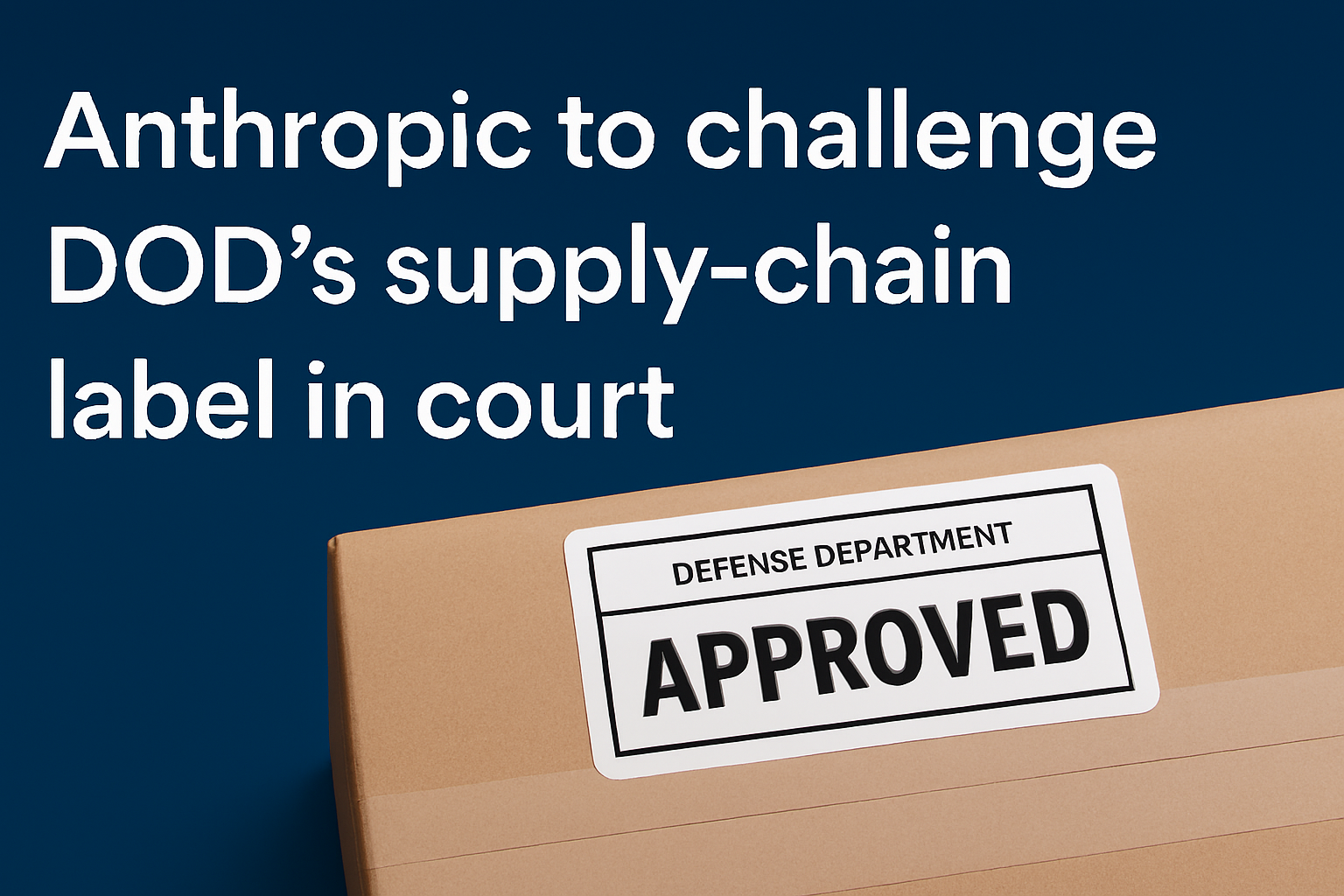
The landscape of artificial intelligence (AI) and government contracting is bracing for a significant legal showdown. In a move that has captured the attention of both the tech world and national security sectors, leading AI company Anthropic has confirmed its intent to challenge the Department of Defense (DOD)’s supply-chain label in court. This decision, emerging from a period of increasing scrutiny over the origins and dependencies of critical technologies, underscores the growing friction between rapid technological innovation and stringent governmental oversight.
Anthropic, known for its advanced large language models like Claude, has become a key player in the AI race. Its collaborations often involve sensitive data and strategic applications, making its classification within the DOD’s supply chain a matter of considerable importance. The company believes that the label applied to it by the DOD is either inaccurate, overly broad, or unfairly restrictive, prompting this robust legal response. The ramifications of this legal challenge could extend far beyond Anthropic itself, potentially setting new precedents for how AI companies interact with federal agencies and how supply chain risks are assessed in an era of globalized tech development.
Understanding the DOD’s Supply-Chain Labels and Their Implications
The Department of Defense utilizes various labels and classifications to assess and mitigate risks within its vast and complex supply chain. These labels are designed to ensure national security, protect against espionage, prevent technological compromise, and guarantee the reliability of systems critical to defense operations. A supply-chain label, in this context, can refer to anything from a vendor’s country of origin, its ownership structure, its dependencies on foreign components, to its adherence to specific security protocols.
For a company like Anthropic, a particular supply-chain label can carry significant weight. It might dictate eligibility for certain contracts, influence investment opportunities, or even impact its standing with other government agencies and private sector partners who adhere to similar risk assessments. The specific nature of the label Anthropic intends to challenge remains largely undisclosed, but generally, such designations can imply perceived vulnerabilities, foreign influence, or an inability to meet stringent security requirements. Being tagged with an unfavorable supply-chain label can be detrimental, limiting an AI firm’s ability to contribute to sensitive projects and potentially stunting its growth in the lucrative government sector.
The DOD’s rationale for imposing such labels is rooted in a proactive approach to national security. With the increasing sophistication of cyber threats and geopolitical competition, ensuring the integrity of every component and service provider in the defense supply chain is paramount. From chips to software algorithms, every element is scrutinized. However, the rapidly evolving nature of AI development, often characterized by open-source contributions, global talent pools, and complex data flows, presents unique challenges for traditional supply chain risk assessment frameworks.
Anthropic’s decision to challenge DOD’s supply-chain label in court suggests a fundamental disagreement over the interpretation or application of these risk frameworks to AI technologies. It posits that the current classification may not accurately reflect its operational security, ownership, or the safeguards it has in place. This legal battle is not merely about a label; it’s about defining the parameters of trust and risk in the critical domain of AI for national defense.

The Core of Anthropic’s Argument: Why the Label is Disputed
While the precise details of Anthropic’s legal filing are yet to be fully public, industry analysts and legal experts can infer several potential lines of argument. One primary contention might revolve around the methodology used by the DOD to assign the label. Is the process transparent? Does it adequately account for the unique operating model of an advanced AI research company? Traditional supply chain assessments often focus on hardware components or established software vendors with clear geographic ties. AI, however, thrives on a different ecosystem.
Anthropic could argue that its internal security protocols, vetting processes for employees, data handling practices, and intellectual property protections are robust enough to mitigate any perceived risks. The company may assert that the DOD’s label is based on outdated criteria or a misunderstanding of how modern AI models are developed, trained, and deployed. For instance, many AI models leverage publicly available datasets or open-source components, which, while beneficial for innovation, can complicate traditional supply chain analysis.
Another angle could be the potential for unfair competitive disadvantage. If the label hinders Anthropic from securing government contracts or collaborating on key projects, it could argue that this stifles innovation and limits the DOD’s access to cutting-edge AI capabilities. In a rapidly evolving field, restricting access to leading developers could have unintended consequences for national security, as other nations continue to advance their AI capabilities.
Furthermore, Anthropic might challenge the evidence or rationale presented by the DOD for its designation. Legal challenges often hinge on the sufficiency of evidence and whether due process was followed. If Anthropic believes the DOD’s assessment was arbitrary, lacked substantial evidence, or failed to provide an adequate opportunity for the company to address concerns, these could form strong grounds for its lawsuit. The company’s proactive stance to challenge DOD’s supply-chain label in court highlights its commitment to protecting its reputation and ensuring its ability to operate freely within the government ecosystem.
For more insights into the challenges and opportunities for AI companies navigating government regulations, you might find valuable information on TechPerByte.com, which frequently covers the intersection of technology and policy.
Broader Implications for the AI Industry and Government Contracts
This legal confrontation between Anthropic and the DOD is more than just a dispute between one company and a government agency; it’s a bellwether for the future of AI in national defense. The outcome could significantly influence how other AI firms are classified, regulated, and engaged by the U.S. government. Should Anthropic succeed in its challenge, it could empower other tech companies to push back against what they perceive as unfair or misguided governmental classifications.
Conversely, if the DOD successfully defends its position, it could solidify the government’s authority to impose strict supply chain controls on emerging technologies, potentially leading to a more cautious and regulated environment for AI development in the defense sector. This could force AI companies to reconsider their operational structures, global partnerships, and component sourcing to align with increasingly stringent governmental requirements. It also raises questions about the balance between national security imperatives and fostering a vibrant, innovative tech ecosystem.
One key area of impact is transparency. The dispute may push both sides towards greater clarity regarding how supply chain risks are defined for AI. The tech community has long advocated for more transparent guidelines, arguing that opaque processes hinder collaboration and create uncertainty. This case could be a catalyst for the development of more standardized, AI-specific risk assessment frameworks that are both robust and adaptable to rapid technological change.
Moreover, the legal battle could illuminate the broader geopolitical competition in AI. Nations worldwide are investing heavily in AI capabilities, and concerns about technology transfer, intellectual property theft, and foreign influence are paramount. How the U.S. manages its domestic AI supply chain, particularly regarding leading-edge firms like Anthropic, will send a powerful signal to international partners and adversaries alike. For a deeper dive into the complexities of AI ethics and regulation, a visit to a site like Reuters could provide valuable context on Anthropic’s market position and related legal precedents.
Navigating the Legal Landscape: Precedents and Challenges
The legal terrain for disputes involving government contracting and national security classifications is often intricate and protracted. Companies challenging federal agencies face a high bar, as courts generally grant significant deference to government decisions made in the interest of national security. However, this does not mean the government is immune to legal scrutiny. Plaintiffs can succeed by demonstrating that an agency acted arbitrarily, capriciously, abused its discretion, or failed to follow proper procedures.
Anthropic’s legal team will likely draw upon administrative law principles, arguing that the DOD’s process was flawed or its conclusions unsupported by evidence. They might also invoke constitutional arguments related to due process or equal protection, asserting that the label unfairly targets Anthropic without adequate justification or opportunity for redress. The specific court where the case is filed—whether it’s the Court of Federal Claims, a District Court, or an appeals court—will also influence the procedural rules and potential remedies available.
The challenge for Anthropic lies in proving that the DOD’s classification is not just inconvenient, but legally unsound. This could involve presenting detailed evidence of its security measures, the independence of its operations, and the minimal risk it poses to national security. The DOD, in turn, will likely present its own classified or unclassified evidence to justify its designation, emphasizing the broad scope of its authority to protect national interests.
Such cases can be lengthy and resource-intensive, requiring substantial legal and technical expertise. The visibility of this case, given Anthropic’s prominence in the AI sector, will undoubtedly mean that legal scholars, industry watchdogs, and policymakers will be following every development closely. The precedent set by this case could impact how future contracts are negotiated and how risk assessments are conducted for innovative technologies across the board.

The Future of AI and National Security Partnership
This legal confrontation, while potentially contentious, also offers an opportunity for greater clarity and better collaboration between the private AI sector and government defense agencies. Both sides ultimately share an interest in advancing robust, secure, and ethical AI capabilities for the benefit of national security. The current dispute over the supply-chain label highlights a communication and perhaps an interpretive gap that needs to be bridged.
One potential outcome is the development of more tailored and sophisticated risk assessment methodologies for AI. Rather than applying generic supply chain rules, future frameworks might incorporate specific considerations for AI models, training data provenance, algorithmic transparency, and the unique vulnerabilities associated with machine learning systems. This could lead to a more nuanced approach that encourages innovation while maintaining stringent security standards.
Another area of potential evolution is in the contractual language and partnership models. Government agencies might explore new ways to structure contracts with AI companies, including clearer guidelines on data sovereignty, intellectual property ownership, and the sharing of security best practices. This proactive approach could help prevent future disputes and foster a more collaborative environment. Organizations like the National Institute of Standards and Technology (NIST) are already working on AI risk management frameworks, and this case could accelerate their adoption and refinement.
The decision by Anthropic to challenge DOD’s supply-chain label in court is a bold statement, reflecting the AI industry’s growing maturity and its willingness to defend its operational integrity. The resolution of this case will undoubtedly shape the contours of national security policy for advanced technologies, influencing everything from procurement processes to international partnerships. It’s a critical moment for defining how innovation and security can coexist and thrive in the age of artificial intelligence. For continued updates on how this impacts the broader tech landscape, make sure to visit TechPerByte.com’s AI News section.
Conclusion: A Defining Moment for AI and Government Collaboration
The news that Anthropic is set to challenge DOD’s supply-chain label in court marks a pivotal moment in the ongoing dialogue between cutting-edge technology companies and the governmental apparatus responsible for national security. This legal battle is not merely about a technical classification; it’s about establishing the rules of engagement for AI developers seeking to partner with the U.S. Department of Defense. It will test the flexibility of existing regulatory frameworks against the dynamic realities of AI innovation.
The outcome could either lead to a more formalized and transparent system for vetting AI technologies in defense contexts or it could entrench existing friction, making collaboration more challenging. Regardless of the immediate victor, the long-term benefit for both the AI industry and national security could be a clearer, more robust, and mutually understood set of guidelines for trust and risk. As AI continues to permeate every aspect of modern life, the ability to effectively and securely integrate these powerful tools into defense strategies will be paramount. This challenge by Anthropic is a crucial step in shaping that future.
#AI #Technology #GovernmentContracts #SupplyChain #LegalTech #NationalSecurity #Anthropic #DOD