How Separating Logic and Search Boosts AI Agent Scalability
How Separating Logic and Search Boosts AI Agent Scalability
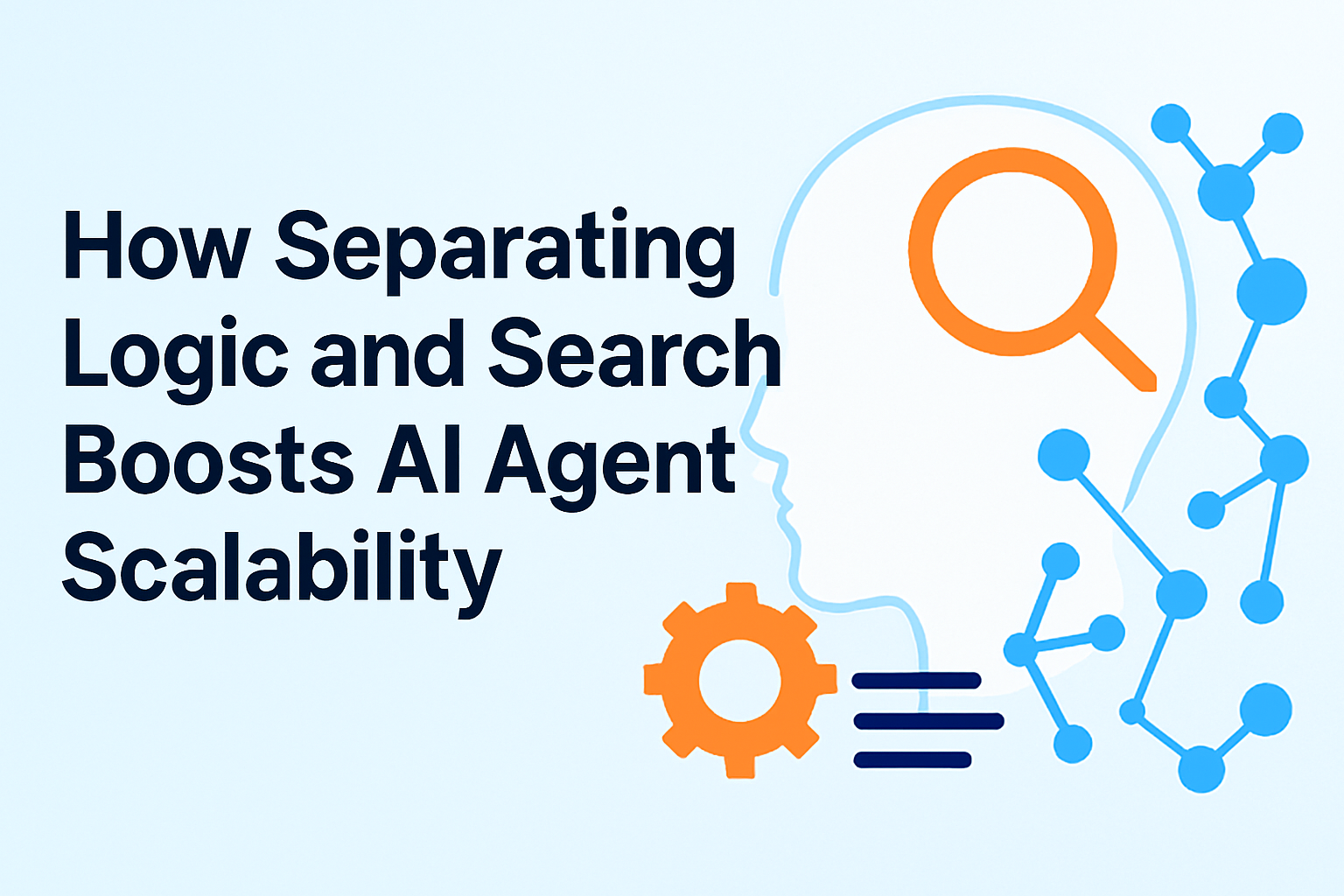
The transition of generative AI from promising prototypes to reliable, production-grade agents has introduced a critical engineering challenge: ensuring consistency amidst the inherent unpredictability of Large Language Models (LLMs). LLMs are stochastic, meaning a prompt yielding a perfect response one moment might fail the next. To counteract this, development teams often intertwine core business logic with complex error handling, retries, and branching paths. This entanglement creates significant technical debt, making agents difficult to maintain, test, and scale. Addressing this challenge head-on is crucial for enterprise adoption, and researchers are now proposing a novel architectural standard that fundamentally changes how separating logic and search boosts AI agent scalability.
A new framework, developed by experts from Asari AI, MIT CSAIL, and Caltech, suggests that decoupling an agent’s core workflow from its inference-time strategies is key. This approach promises to simplify development, reduce maintenance overhead, and pave the way for more robust and scalable AI agents in real-world applications.
The Entanglement Problem in AI Agent Design
Current methods for programming AI agents frequently conflate two distinct, yet often intertwined, design elements. The first is the fundamental workflow logic – the precise sequence of steps an agent must execute to complete a defined business task. The second is the inference-time strategy, which dictates how the system intelligently navigates the uncertainties inherent in LLM operations, such as generating multiple output drafts or validating results against specific criteria.
When these two elements are combined, the resulting codebase becomes notoriously brittle and difficult to manage. For instance, implementing a seemingly simple strategy like “best-of-N” sampling often requires wrapping the entire agent function in iterative loops. Shifting to more sophisticated strategies, such as tree search or complex refinement processes, typically demands a complete structural rewrite of the agent’s underlying code. This high cost of experimentation severely limits a development team’s ability to innovate and optimize. Teams often settle for suboptimal reliability strategies, not due to lack of expertise, but to avoid the prohibitive engineering overhead involved in re-architecting their applications every time they wish to try a new approach to handling LLM unpredictability.
Introducing the Decoupled Architecture: PAN and ENCOMPASS
To address this entanglement, the research introduces a programming model called Probabilistic Angelic Nondeterminism (PAN) and its Python implementation, ENCOMPASS. This innovative framework allows developers to write the “happy path” of an agent’s workflow, focusing solely on the core business logic, while abstracting away the complexities of inference-time strategies. The core idea is to mark “locations of unreliability” within the code using a primitive called branchpoint(). These markers indicate where an LLM call occurs and where execution might potentially diverge.
At runtime, ENCOMPASS interprets these branch points to dynamically construct a search tree of possible execution paths. This architecture enables what the authors term “program-in-control” agents. Unlike “LLM-in-control” systems, where the model dictates the entire sequence of operations, program-in-control agents operate within a workflow rigorously defined by code. The LLM is invoked only to perform specific subtasks, offering higher predictability and auditability – qualities highly valued in enterprise environments. By treating inference strategies as a search over execution paths, ENCOMPASS empowers developers to apply diverse algorithms—such as depth-first search, beam search, or Monte Carlo tree search—without altering the underlying business logic. This separation is key to how separating logic and search boosts AI agent scalability.
A New Paradigm for Enterprise AI
The “program-in-control” paradigm offers a significant advantage for enterprises seeking to deploy AI agents at scale. It ensures that the overall workflow remains transparent and auditable, a non-negotiable requirement for regulated industries and critical business operations. Engineers can clearly define the steps an agent should take, and the LLM’s role becomes that of a specialized tool within a well-defined process. This contrasts sharply with opaque, fully autonomous “LLM-in-control” systems that can be difficult to debug, audit, and trust. For more insights on robust AI deployments, you can explore resources at TechPerByte.
Real-World Impact and Cost Efficiency
The utility of this decoupled approach is powerfully demonstrated in complex workflows such as legacy code migration. Researchers applied the ENCOMPASS framework to an agent designed to translate Java repositories to Python, file-by-file. This workflow involved translation, input generation, and validation via execution. In traditional Python implementations, adding search logic for reliability necessitated defining a state machine, which obscured the business logic and made the code difficult to read and maintain. Implementing beam search required manually breaking down the workflow into individual steps and meticulously managing state across a dictionary of variables.
Using the ENCOMPASS framework, the same search strategies were implemented by simply inserting branchpoint() statements before LLM calls. The core logic remained linear, readable, and clean. The study revealed that applying beam search at both the file and method level significantly outperformed simpler sampling strategies. The data indicates that separating these concerns allows for better scaling laws; performance improved linearly with the logarithm of the inference cost. Crucially, the most effective strategy identified – fine-grained beam search – would have been prohibitively complex to implement using conventional coding methods.
Scaling Performance, Not Just Loops
Controlling inference costs is a paramount concern for data officers managing the P&L of AI projects. This research demonstrates that sophisticated search algorithms can yield superior results at a lower cost compared to merely increasing the number of feedback loops. For example, in a case study involving the “Reflexion” agent pattern (where an LLM critiques its own output), the researchers compared scaling the number of refinement loops against using a best-first search algorithm. The search-based approach achieved comparable performance to the standard refinement method but at a substantially reduced cost per task.
This finding underscores that the choice of inference strategy is a pivotal factor for cost optimization. By externalizing this strategy, teams can fine-tune the balance between compute budget and required accuracy without rewriting the application. A low-stakes internal tool might employ a cheap and greedy search strategy, while a customer-facing application could utilize a more expensive and exhaustive search – all running on the same underlying codebase, enhancing agility and reducing time-to-market. For further reading on optimizing AI workflows, visit TechPerByte.
Navigating the Road Ahead: Challenges and Strategic Implications
Adopting an architecture like PAN and ENCOMPASS requires a shift in how development teams approach agent construction. While the framework drastically reduces the code needed to implement search, it doesn’t automate the agent’s design itself. Engineers must still judiciously identify the correct locations for branchpoint() markers and define verifiable success metrics – a reliable scoring function remains a bottleneck, especially in subjective domains like summarization or creative generation. Furthermore, while the framework handles variable scoping and memory management, developers must ensure that external side effects (e.g., database writes, API calls) are correctly managed to prevent duplicate actions during the search process.
Despite these engineering considerations, the architectural change represented by PAN and ENCOMPASS aligns perfectly with broader software engineering principles of modularity and separation of concerns. As agentic workflows become increasingly central to enterprise operations, their maintenance will demand the same rigor applied to traditional software. Hard-coding probabilistic logic directly into business applications creates insurmountable technical debt, making systems difficult to test, audit, and upgrade.
Decoupling the inference strategy from the core workflow logic allows for independent optimization of both. This separation also facilitates superior governance. If a specific search strategy leads to hallucinations or errors, it can be adjusted globally without needing to assess every individual agent’s codebase. It simplifies the versioning of AI behaviors – a critical requirement for regulated industries where the “how” of a decision is as vital as the outcome. The research, contributed by institutions like MIT CSAIL, strongly suggests that enterprise architectures that isolate the complexity of managing execution paths will prove more durable and scalable than those that allow it to permeate the application layer. Integration with existing tools like LangChain is also part of this vision, operating at a different layer of the stack to manage control flow rather than prompt engineering.
Conclusion
The journey from experimental generative AI to production-ready enterprise agents is paved with engineering challenges, primarily stemming from the inherent unpredictability of LLMs. The proposed architectural standard, embodied by PAN and ENCOMPASS, offers a powerful solution by elegantly separating core business logic from inference-time search strategies. This decoupling not only reduces technical debt and simplifies maintenance but also dramatically boosts AI agent scalability and reliability. By enabling easier experimentation with sophisticated search algorithms, optimizing costs, and fostering clearer governance, this approach represents a pivotal step towards building robust, adaptable, and truly scalable AI systems for the future of enterprise technology.
#Technology
#AI
#Scalability