
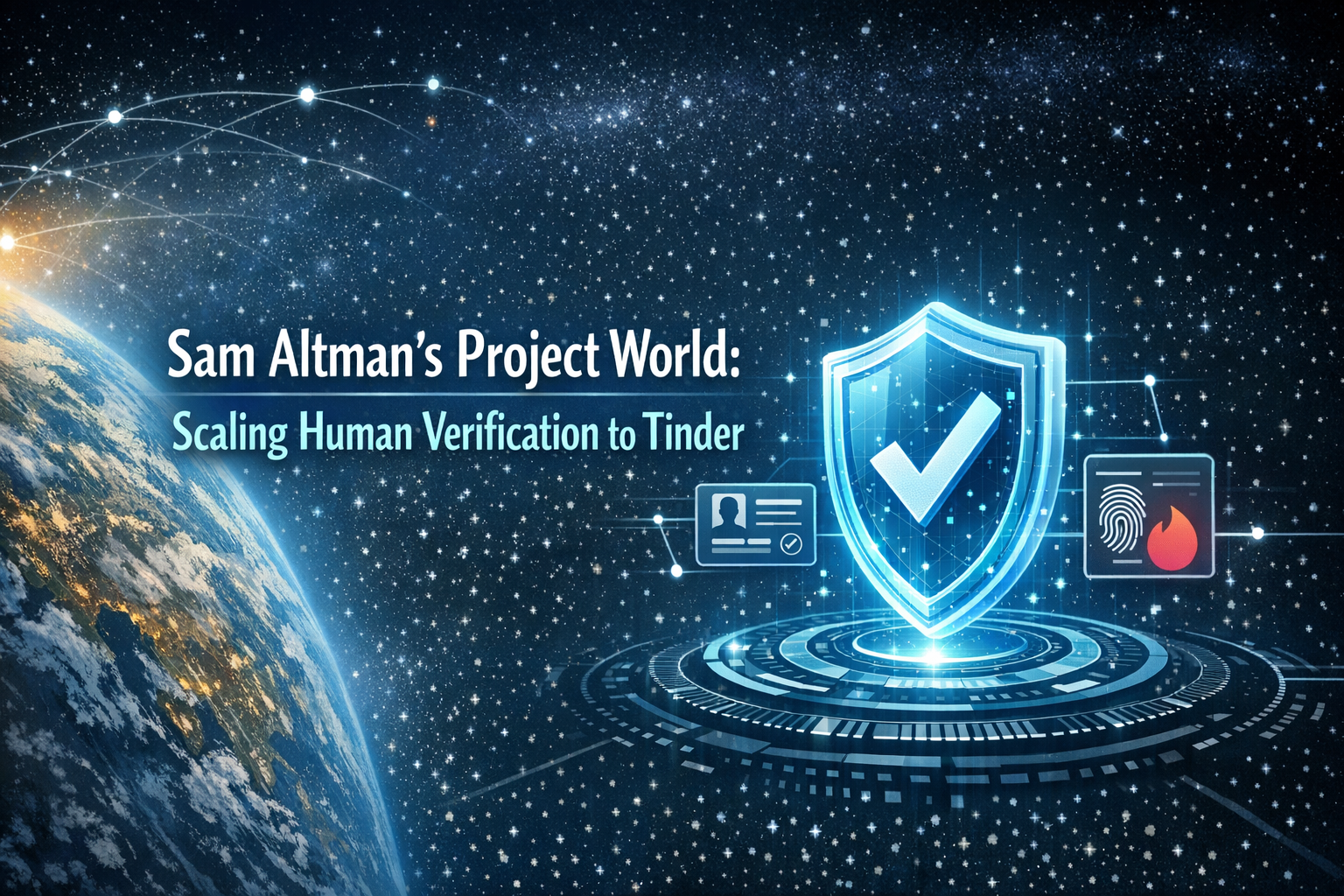
Sam Altman’s project World: Scaling Human Verification to Tinder
In a significant development set to redefine online identity and trust, news confirms that Sam Altman’s project World looks to scale its human verification empire. First stop: Tinder. This strategic move for Worldcoin, the ambitious venture co-founded by OpenAI’s Sam Altman, marks a pivotal step in its quest to establish a global “proof of personhood” system. The potential integration with Tinder, one of the world’s largest dating applications, presents a compelling opportunity to address the pervasive issues of bots, scams, and fraudulent profiles that plague digital platforms worldwide.
The digital realm, for all its connectivity and innovation, continues to grapple with a fundamental challenge: verifying the genuine identity of individuals interacting online. From social media to e-commerce, and particularly in dating apps, the proliferation of sophisticated AI, deepfakes, and rampant bot activity has steadily eroded user trust and experience. Worldcoin’s core offering, World ID, seeks to provide a unique digital identity that confirms an individual’s humanness while meticulously protecting their privacy. This journey to establish a robust, universally accessible human verification system is now taking a concrete and high-profile turn with its reported initial foray into the notoriously complex and often problematic landscape of online dating.
Why Tinder Needs Robust Human Verification More Than Ever
Tinder, boasting millions of users globally, serves as an apt illustration of the internet’s broader identity crisis. While designed to foster connections, its success is frequently hampered by a wide array of malicious actors. Users on the platform routinely encounter:
- Catfishing Scams: Individuals employing fake photos, identities, or fabricated stories to deceive others for various motives.
- Bots and Spam Accounts: Automated profiles designed to lure users into phishing scams, promote dubious services, or collect personal data.
- Harassment and Abuse: The relative anonymity provided by digital profiles can embolden bad actors to engage in disrespectful or harmful behavior with reduced accountability.
- Financial Fraud: Scammers painstakingly build trust and relationships, often over extended periods, before eventually soliciting money under false pretenses.
These challenges not only degrade the overall user experience but also introduce significant safety and security risks. Despite Tinder and other dating platforms implementing various verification methods—such as photo verification, social media linking, and premium subscriptions—these measures often prove insufficient against sophisticated and determined scammers. The urgent need for a more robust, secure, and privacy-preserving method to confirm that each profile genuinely belongs to a unique human being is becoming increasingly undeniable.
This is where World ID steps in. The prospect that Sam Altman’s project World looks to scale its human verification empire. First stop: Tinder, offers a promising solution for cultivating a more authentic and secure online dating environment. By potentially integrating World ID, Tinder could empower its users with an optional, yet profoundly impactful, layer of verification, ensuring that interactions are indeed human-to-human. This could fundamentally alter the dynamics of trust on the platform, encouraging more genuine connections and substantially reducing the prevalence of fraudulent and deceptive activity.
The implications of such an integration extend far beyond mere nuisance reduction. It addresses a deeper, more critical need for digital safety, accountability, and psychological well-being. Imagine an online dating experience where you can engage with a reasonable degree of certainty that the person you are communicating with is precisely who they claim to be – a real, unique individual. This level of assurance has the potential to revolutionize the online dating landscape, making it safer, more enjoyable, and ultimately, far more effective for its intended purpose of connecting people authentically.

How World ID Works: The Orb and Proof of Personhood
At the core of Worldcoin’s ambitious system lies the World ID, envisioned as a universal digital passport for the internet. To obtain a World ID, users must undergo a singular verification process involving a proprietary physical device known as “The Orb.” This specialized biometric imaging device meticulously scans a user’s iris, subsequently converting the intricate pattern into a unique, anonymous numerical code. This code is then utilized to verify that the individual is indeed a real, unique person, critically, without directly linking their personal data or identity to the ID itself. The overarching promise is to deliver a privacy-preserving and robust “proof of personhood.”
The Orb’s advanced technology is engineered to foster a global network of human-verified individuals. Once successfully verified, a user is issued a World ID, which can then be deployed to prove their humanness across any integrated digital platform. This innovative approach suggests that a user could undergo verification once with The Orb and subsequently leverage that World ID across a myriad of online services, theoretically providing a potent defense against bots and fake accounts everywhere. The true ingenuity of the system lies in its capacity to offer strong verification without necessitating the storage or repeated sharing of sensitive personal identifying information (PII) with every service the user interacts with. This distinction is paramount for adequately addressing the substantial privacy concerns inherently associated with any large-scale biometric identification system.
For platforms such as Tinder, integrating World ID could translate into offering users the option to securely link their verified World ID to their profile. This wouldn’t necessarily supersede existing profile data but would crucially append an unimpeachable layer of “I am human” verification. Such an opt-in system has the potential to empower users who prioritize signaling their authenticity and who wish to interact predominantly with other verified users, thereby cultivating a premium experience built on a foundation of trust. The potential for Sam Altman’s project World looks to scale its human verification empire. First stop: Tinder, to revolutionize dating trust is immense.
Addressing Privacy Concerns with Worldcoin
Any project involving the collection and processing of biometrics on a global scale inherently triggers significant privacy concerns. Worldcoin has, predictably, faced its share of scrutiny regarding data collection practices, storage protocols, and the potential for unauthorized misuse. However, the project consistently emphasizes its unwavering commitment to user privacy through the implementation of several key mechanisms:
- Zero-Knowledge Proofs: Worldcoin employs advanced cryptographic techniques that enable users to demonstrate they possess a valid World ID without divulging any underlying personal information. This means the system can confirm your humanness, but it cannot ascertain *who* you are, nor does it permanently store your raw iris scan data.
- Data Minimization: The Orb is specifically designed to capture only the absolute minimum data necessary to generate the unique iris code, and the original iris image is reportedly deleted immediately following processing. The resulting World ID is a privacy-preserving hash, not a re-creatable image.
- Decentralization: World ID is architected upon blockchain technology, aiming to establish a decentralized and permissionless system where individuals retain sovereign control over their own digital identity, rather than entrusting it to a single central authority.
Despite these comprehensive assurances, public debate persists, particularly concerning the ethical ramifications of scanning human irises for a universal digital identity. The ultimate success of Sam Altman’s project World looks to scale its human verification empire. First stop: Tinder, will hinge heavily on how effectively Worldcoin can communicate and demonstrably uphold its privacy-first approach, especially to a user base as sensitive and diverse as those navigating dating applications. Unwavering transparency, robust security audits, and clear, tangible user benefits will be paramount to building public trust and achieving widespread adoption. For more insights on securing your digital footprint, visit TechPerByte.com.
The Broader Vision: A Digital Passport for the Internet
While the immediate focus on Tinder highlights a practical and relatable application, Worldcoin’s long-term ambition extends far beyond the confines of dating apps. The project envisions World ID as a foundational, interoperable layer for a new internet economy, providing a universal digital passport that can be utilized for an expansive range of online interactions and services.
Consider the transformative possibilities across various sectors:
- Financial Services: Providing irrefutable proof of humanness for Decentralized Finance (DeFi) protocols, thereby preventing Sybil attacks, combating fraud, and ensuring the fair and equitable distribution of funds.
- Social Media: Dramatically reducing the prevalence of bot accounts, effectively combating the spread of misinformation, and fostering more authentic, trustworthy online communities.
- E-commerce: Significantly enhancing security for online transactions, minimizing chargebacks resulting from fraudulent purchases, and building greater buyer-seller trust.
- Government Services: Streamlining secure access to public services and benefits, ensuring that these resources reach genuine citizens and preventing identity fraud.
- Universal Basic Income (UBI): A long-term, audacious vision of Worldcoin is to potentially facilitate a global Universal Basic Income, where universally verified humans can receive regular payouts, ensuring equitable distribution without the risk of multiple claims by single individuals or automated bots.
The integration with Tinder, therefore, is not merely about a single application; it functions as a critical proof of concept. If World ID can successfully address the complex identity challenges present on a high-volume platform like Tinder, it will powerfully validate its potential to become a widespread and indispensable solution across the entire digital ecosystem. This strategic scaling approach is absolutely crucial for Worldcoin’s long-term viability, broad impact, and its ability to shape the future of online interactions. For Sam Altman’s project World looks to scale its human verification empire. First stop: Tinder, this initial foray is more than just a partnership; it’s a critical stress test. Discover more about the evolving landscape of digital identity on TechPerByte.com.

Practical Implications for Users and Platforms
The potential integration of World ID into Tinder carries profound practical implications, offering significant benefits for both its vast user base and the platform itself.
For Users: Enhanced Trust and Safety
- Safer Interactions: Users will experience a markedly reduced risk of encountering bots, sophisticated scammers, and deceptive catfishing profiles. This fosters a much more secure and trustworthy environment for initiating and nurturing personal connections.
- Authenticity Assurance: The option to verify one’s humanness via World ID provides a powerful, verifiable signal of authenticity. This could lead to more genuine matches, deeper conversations, and ultimately, more fulfilling interactions, as individuals can confidently seek out other verified users.
- Reduced Harassment: Increased accountability for verified users, even if their World ID is pseudonymous, could act as a significant deterrent against harassment, cyberbullying, and other abusive behaviors, as identities are linked to a unique human ID.
- Improved User Experience: Less time and emotional energy will be wasted on fake profiles, spam, and fraudulent overtures, allowing users to focus more effectively on finding genuine connections and enjoying the dating process.
For Platforms (like Tinder): Cleaner Ecosystem and Brand Reputation
- Reduced Fraud and Abuse: A substantial decrease in fraudulent accounts, bot activity, and malicious operations, leading to a significantly cleaner and more trustworthy user base that enhances the platform’s integrity.
- Enhanced Brand Image: Positioning Tinder as a pioneering leader in secure and authentic online dating, which can attract users who prioritize safety, genuine connections, and a high-quality experience.
- Operational Efficiency: Less resources will need to be expended on combating bots, moderating fraudulent content, and managing complex fraud detection systems, freeing up valuable operational capacity.
- Improved Data Integrity: A more reliable, human-verified user base inherently improves the quality of data available for analytics, product development, and machine learning models, leading to better-tailored features and services.
The core challenge, undeniably, will be striking the right balance between achieving widespread adoption and rigorously maintaining user privacy, while also addressing potential equity issues related to access to The Orb verification devices. Nevertheless, the benefits of cultivating cleaner, more trustworthy digital environments are profound and undeniable. The strategic move by Sam Altman’s project World looks to scale its human verification empire. First stop: Tinder, sets a significant precedent for how major consumer platforms might effectively tackle these pervasive and growing identity-related issues head-on. Read more on how new technologies are shaping online trust at The Verge on Worldcoin.
Challenges and the Road Ahead for Altman’s World Project
While the prospect of World ID scaling its human verification capabilities to high-profile platforms like Tinder is undeniably exciting, the journey ahead is complex and fraught with significant challenges. The path to widespread adoption and universal acceptance for Worldcoin will necessitate navigating a multifaceted landscape of technological, regulatory, and ethical considerations.
Firstly, the sheer logistical undertaking of deploying The Orb globally and ensuring genuinely equitable access for billions of potential users remains a formidable hurdle. While Worldcoin has made discernible strides in expanding its network of Orb operators, reaching every corner of the globe for a physical biometric scan represents an immense and unprecedented endeavor. Critical questions regarding the digital divide, infrastructural limitations, and accessibility in remote or underserved areas will require meticulous planning and innovative solutions.
Secondly, regulatory scrutiny surrounding biometric data collection and privacy laws exhibits considerable variation across different jurisdictions worldwide. Worldcoin will be compelled to ensure meticulous compliance with a complex and often disparate patchwork of global regulations, ranging from GDPR in Europe to diverse data protection statutes in numerous other regions. Successfully navigating this intricate regulatory landscape is absolutely crucial for mitigating legal challenges and fostering essential public trust.
Thirdly, public perception and trust are inherently fragile and must be carefully cultivated. The controversies that have surrounded Worldcoin, particularly concerning its data collection methodologies and the very concept of iris scanning for a global ID, have generated a degree of skepticism. Transparent communication, rigorous independent security audits, and clearly articulated, tangible user benefits will be indispensable in overcoming these existing reservations. The project must continually demonstrate that its privacy safeguards are robustly effective and that the substantial benefits genuinely outweigh any perceived risks.
Finally, the digital identity space is becoming increasingly competitive, with various projects exploring alternative methods for proof of personhood. Some solutions are based on social graph analysis, others on behavioral patterns, and still others employ different biometric modalities. Worldcoin must consistently innovate and unequivocally demonstrate the superiority of its solution in terms of security, privacy, and scalability. Its capacity to successfully integrate with high-profile applications such as Tinder will serve as a critical litmus test for its broader viability and its ultimate influence on the future trajectory of online identity. The journey for Sam Altman’s project World looks to scale its human verification empire. First stop: Tinder, will undoubtedly shape perceptions and adoption on a global scale.
The partnership with Tinder, therefore, is more than just a pilot program; it is a profound test of Worldcoin’s resilience, its technological prowess, and its ability to effectively win over public opinion. If successful, it possesses the potential to herald a new and transformative era of trust and authenticity across the entire online sphere. However, if it falters, it will starkly highlight the deep-seated complexities and formidable challenges inherent in attempting to construct a truly universal digital identity system in a world that is increasingly wary of centralized control and the potential for data exploitation. The stakes are undeniably high for Worldcoin and, by extension, for the very future of human verification in the digital age.
Conclusion: A New Chapter for Online Trust
The recent announcement that Sam Altman’s project World looks to scale its human verification empire. First stop: Tinder, marks a truly pivotal moment in the ongoing, critical battle for online authenticity and trust. By strategically targeting a platform that so vividly embodies the myriad challenges of digital identity – from the relentless onslaught of bots and scams to the pervasive issue of catfishing – Worldcoin is taking a bold and unequivocal step towards demonstrating the real-world, tangible applicability of its World ID system.
While legitimate questions surrounding privacy, accessibility, and regulatory compliance will undoubtedly persist and demand ongoing attention, the fundamental and growing need for robust, reliable human verification in our increasingly digital lives is undeniable. A future where dating apps, social media platforms, and essential financial services can reliably distinguish between a genuine human and an automated bot offers a compelling and deeply appealing vision of a safer, more trustworthy, and ultimately more humane internet. The integration with Tinder serves as an absolutely critical proving ground, and its eventual success or failure will offer invaluable lessons that will profoundly influence the broader adoption and future trajectory of decentralized, privacy-preserving digital identities. It is an exciting, albeit challenging, new chapter that promises to reshape online trust and redefine the very evolution of our digital selves.
#AI
#Technology
#Worldcoin
#HumanVerification
#DigitalIdentity
#SamAltman
#Tinder
#OnlineSafety
#Biometrics
#Web3
#IdentityVerification